
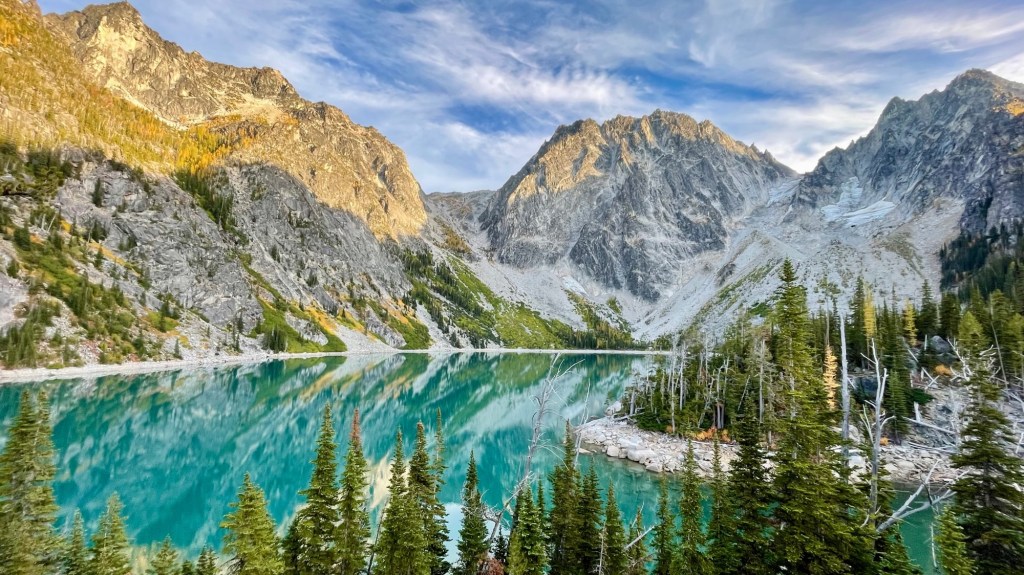
The Pacific Crest Trail—often shortened to the PCT—is a 2,650-mile footpath that stretches from the border of Mexico to the border of Canada, cutting through California, Oregon, and Washington. It’s best known for epic views, blistered feet, and the kind of personal revelations that tend to arrive sometime after your third consecutive day of instant mashed potatoes.
It’s also, somewhat inconveniently, a hiking trail.
This matters because hiking is not one of my passions. I don’t dislike nature, exactly—I can appreciate a nice view—but it has never been my happy place. Long walks, silence, and intentional discomfort have rarely made it onto my list of preferred activities.
So why am I preparing to spend four to six months walking across the western United States?
The short answer is: a book, my dad, and a growing suspicion that I’ve been a little too comfortable.
A year ago, this idea wouldn’t have interested me in the slightest. Then, during a visit to my dad’s, I finally returned a book he had loaned me years earlier: The Comfort Crisis by Michael Easter. Out of politeness—and mild curiosity—I started reading it.
That turned out to be a mistake. Or a gift.
The book argues that in a world engineered for comfort, we’ve lost something essential. Discomfort, boredom, and time spent in nature aren’t obstacles to a good life; they’re often the very things that sharpen our thinking, strengthen our character, and give us clarity. Silence, it turns out, is not empty.
This landed uncomfortably close to home. I had spent years optimizing my life for efficiency, stimulation, and measurable outcomes. The idea that quiet and difficulty might be useful stopped me in my tracks. Somewhere between chapters, my internal compass shifted. I began wanting less noise and more space—less distraction, more restraint.

Enter my dad.
My dad is, quite simply, an outdoor savant. He completed the PCT in 2021, nearly finished the Continental Divide Trail, and has spent decades backpacking, mountain climbing, and wandering through wild places. Nature is his element. Put him on trail and he looks like a kid who’s been handed the keys to a candy store.
One day, while catching up on the phone, he said, “Hey, Kate! I was just about to text you.”
“Oh?” I said. “What’s up?”
“I’m going to hike the PCT again this summer.”
What followed was a rapid sequence of emotions: excitement, disbelief, fear, and a very quiet internal voice saying, Well… that’s interesting.
I asked if I could join him for a couple of weeks.
Two weeks became a month. A month became a section. A section became a permit.
And suddenly, I was planning a thru-hike.

The PCT is considered beginner-friendly as far as long trails go, but “beginner-friendly” is still doing a lot of work in that sentence. Having a veteran beside me—someone who has already made the mistakes and learned the lessons—is invaluable. It also means I can focus less on spreadsheets and more on why I’m there in the first place.
Which brings me to the harder part.
Leaving for the trail requires real sacrifice. Over the past six years, I’ve built a life I genuinely love in my small town in North Carolina. I have a strong gym community, thoughtful friends, a family I’m close to, a mother who is my biggest supporter, and an embarrassing number of beloved cats.
I’m happy here.
Hiking the PCT means pausing all of that. I’ll leave my job, drain a good portion of my savings, and walk away from routines and relationships I worked hard to build. What comes after the trail is not a neatly packaged plan—it’s an idea, at best.
And still, I’m going.
Not to escape my life, but to examine it.
I’m hiking the PCT because I want space to think.
Long days of walking create an unusual kind of clarity. There’s no constant input, no endless choices, no background noise. Life becomes very simple: walk, eat, sleep, repeat. In that simplicity, people tend to find insight—about who they are, what matters, and where they’re going.
I don’t expect enlightenment at mile 742. I do expect to be challenged—mentally far more than physically. (As my dad has kindly pointed out, for once I may be in better shape than he is.) I expect boredom, frustration, humility, and probably a few moments where I question my decision-making skills.
I also expect wisdom.
“As long as you don’t get injured,” my dad told me during one of our planning calls, “this will probably be the best summer of your life.”
Most people on trail say something similar.
So no, I don’t love hiking. But I do love thinking, creating, and learning. I love opportunities that stretch me in ways I can’t predict. And when an invitation appears at exactly the right moment—one that offers challenge, companionship, and the chance to listen more closely to my own thoughts—I’ve learned it’s worth saying yes.
On y va!
 The Wonderland Journal
Leave a comment